Solar shingles cost between $21 to $25 per square foot installed in 2026, translating to $50,000 to $75,000 for a typical 2,500-square-foot roof. That’s roughly double the investment of traditional rooftop solar panels, but you’re paying for both a new roof and a power system in one integrated package.
The price difference between a budget installation and a premium one comes down to four main factors. Your roof’s complexity matters more than you might think. A simple gable roof costs significantly less to cover than one with multiple dormers, valleys, or steep pitches that slow down installation. System capacity drives cost too. A 10-kilowatt system generates more power but requires more shingles and equipment than a 5-kilowatt setup.
Geography plays a substantial role. Installation labor in California or New York runs 20 to 40 percent higher than in the Midwest or Southeast. The manufacturer you choose also affects your bottom line. Tesla’s Solar Roof commands premium pricing, while newer manufacturers offer competitive alternatives at lower price points.
Understanding how solar works helps clarify why these systems cost what they do. Solar shingles function identically to panels, converting sunlight into electricity, but they’re engineered as building materials first. That dual purpose requires more sophisticated manufacturing and specialized installation skills, which drives up the investment compared to standard solar arrays.
The good news? Financing options, federal incentives, and potential energy savings of $1,500 to $3,000 annually can make this technology more accessible than the sticker price suggests.
Solar Shingle Cost by Roof Size
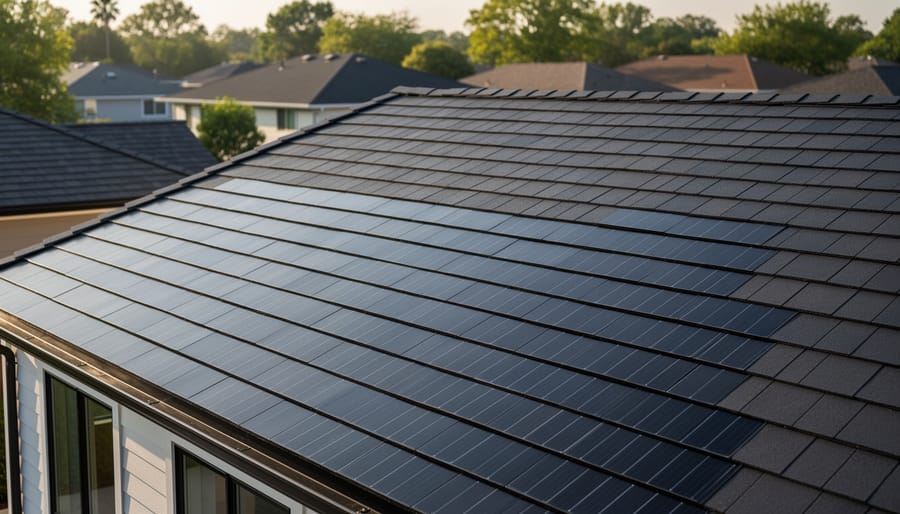
Solar shingle pricing scales directly with your roof size, since both material quantities and labor hours increase as square footage grows. The total investment includes both the solar shingles themselves and professional installation, with costs typically ranging from $21,000 for smaller roofs to well over $60,000 for larger homes.
Here’s what you can expect to pay based on common residential roof sizes:
| Roof Size | Estimated Shingles Needed | Material Cost | Installation Cost | Total Cost |
|---|---|---|---|---|
| 1,000 sq ft | 3,000-3,500 | $14,000, $17,000 | $7,000, $9,000 | $21,000, $26,000 |
| 1,500 sq ft | 4,500-5,250 | $21,000, $25,500 | $10,500, $13,500 | $31,500, $39,000 |
| 2,000 sq ft | 6,000-7,000 | $28,000, $34,000 | $14,000, $18,000 | $42,000, $52,000 |
| 2,500 sq ft | 7,500-8,750 | $35,000, $42,500 | $17,500, $22,500 | $52,500, $65,000 |
| 3,000+ sq ft | 9,000+ | $42,000+ | $21,000+ | $63,000+ |
These figures assume a complete solar shingle roof replacement with a mix of active solar shingles and standard protective shingles. Not every shingle on your roof needs to generate electricity, installers strategically place active solar shingles on south-facing slopes and areas with optimal sun exposure, while using less expensive non-solar shingles in shaded sections or on north-facing slopes.
The price per square foot typically decreases slightly as projects scale up, since fixed costs like permits, electrical work, and initial setup are spread across more material. A 1,000 square foot installation might run $21, $26 per square foot, while a 3,000 square foot roof could drop to $20, $22 per square foot for the same quality system.
Your actual costs will vary based on roof complexity, your geographic location, the brand you select, and how much of your roof receives direct sunlight suitable for active solar shingles. Homes with complicated rooflines featuring multiple dormers, valleys, or steep pitches will land at the higher end of these ranges.
What’s Included in Solar Shingle Installation Costs
Material Costs
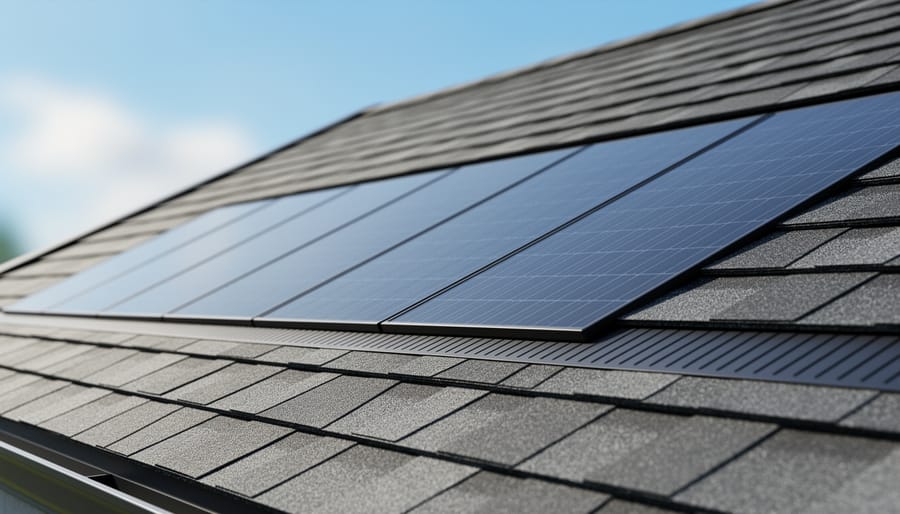
Material costs make up roughly 40-60% of your total solar shingle investment, though this varies by manufacturer and system design. Unlike traditional panels measured per watt, solar shingles are typically priced both per watt and per square foot of coverage, since you’re installing them as your actual roof surface.
Expect to pay $4, $7 per watt for the solar shingles themselves before installation. For a typical residential system generating 10 kilowatts, that translates to $40,000, $70,000 in materials alone. However, this figure includes both active solar shingles and standard protective shingles for non-solar portions of your roof.
Tesla Solar Roof sits at the premium end, typically running $6, $7 per watt with integrated design that requires their proprietary installation approach. GAF Energy’s Timberline Solar shingles cost $5, $6 per watt and integrate with standard GAF roofing products, simplifying installation on some projects. CertainTeed’s Apollo II system generally falls in the $4.50, $5.50 per watt range, offering a more budget-conscious option while maintaining quality.
Coverage rates matter significantly to your total material cost. Most systems need 350-400 shingles per 1,000 square feet of roof area, but only 60-80% of those are active solar-generating shingles. The rest are standard protective shingles that match the appearance but cost $1, $2 per square foot instead of $15, $20.
Understanding these solar shingle cost inputs helps you evaluate quotes accurately. Unlike a solar panel diagram showing separate mounting systems, solar shingles function as both roof protection and power generation, which explains their higher per-watt pricing compared to conventional panels.
Installation Labor
Professional solar shingle installation typically costs $3 to $6 per watt for labor alone, which translates to roughly $50 to $100 per square foot of roof coverage. For a standard 10-kilowatt system, you’re looking at $30,000 to $60,000 in labor charges on top of materials.
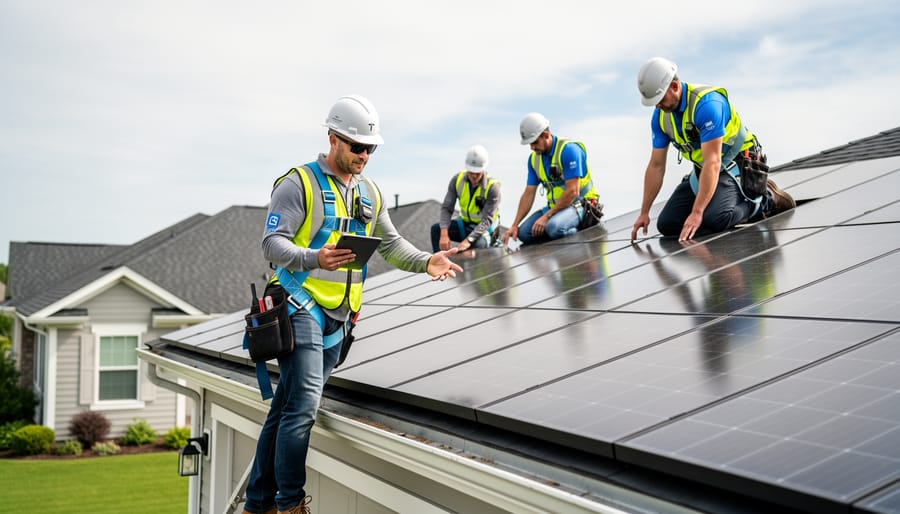
Most installations require a crew of four to six specialized technicians who combine roofing and electrical expertise. A typical residential project takes seven to fourteen days to complete, depending on roof complexity and size. This extended timeline reflects the meticulous nature of the work compared to a standard roof replacement, which might take just three to five days.
Solar shingles demand expertise that goes well beyond traditional roofing. Installers must properly integrate photovoltaic technology with waterproofing systems, make precise electrical connections between individual shingles, wire the system to your home’s electrical panel, and ensure every component meets building codes. Each shingle must be positioned for optimal energy production while maintaining structural integrity and weather protection. This dual requirement means finding contractors certified in both roofing and solar electrical work, which is why labor represents such a significant portion of total costs.
Additional Components and Fees
Beyond the solar shingles themselves and installation labor, several additional components and fees contribute to your total project cost. Understanding these expenses helps you budget accurately and avoid surprises when reviewing installer quotes.
Essential additional costs include:
- Inverter system: $1,000, $3,000 depending on system size and whether you choose string inverters or microinverters
- Electrical panel upgrade: $1,500, $3,000 if your existing panel can’t handle the added solar capacity
- Permits and inspections: $500, $2,000 varying significantly by municipality
- Roof deck preparation or repair: $1,000, $5,000 if underlayment, flashing, or structural repairs are needed
- Old roof removal and disposal: $1,000, $4,000 depending on existing material and local dump fees
- Monitoring system: $300, $800 for equipment that tracks your energy production
- Trenching and conduit: $500, $1,500 for running electrical connections from roof to inverter and panel
The inverter is particularly critical since it converts the DC electricity your shingles generate into AC power your home uses. Microinverters cost more upfront but can improve system performance on complex roofs with shading issues. Permit costs vary dramatically by location, some jurisdictions charge flat fees while others calculate based on system size. Always confirm whether your installer’s quote includes permit acquisition and inspection scheduling, as some contractors list these separately.
Factors That Affect Solar Shingle Pricing
Roof Complexity and Condition
A simple gable roof with moderate pitch costs significantly less to outfit with solar shingles than a complex roof with multiple angles, valleys, and architectural features. Steep pitches above 7:12 require additional safety equipment and slow down installation, typically adding 10-20% to labor costs. Each valley, dormer, or roof plane change increases cutting and customization work, driving up both material waste and installation time.
If your existing roof needs repairs or replacement, you’ll pay for that work before solar shingles go on. Rotted decking, damaged rafters, or outdated electrical panels must be addressed first, potentially adding $2,000-$8,000 to your project. However, if you’re already planning a roof replacement, solar shingles become more cost-effective since you’re combining two projects into one.
Roof accessibility also matters. A two-story home with limited staging areas or tight lot lines requires more setup time and specialized equipment than a single-story ranch with easy access. Installers may charge premium rates for roofs that require crane lifts or extensive scaffolding to work safely.
Geographic Location
Where you live plays a major role in what you’ll pay for solar shingles. Labor rates vary dramatically by region, installers in California or Massachusetts typically charge $75, $125 per hour, while crews in the Midwest or South might run $50, $75 per hour. Permit fees range from a few hundred dollars in rural counties to $2,000+ in cities like San Francisco or New York.
Climate matters too. Homes in snow-heavy areas need reinforced installations and may require additional weatherproofing, adding 10-15% to costs. Meanwhile, coastal regions with salt exposure often mandate corrosion-resistant components.
Installer availability is the hidden cost driver. Markets with few qualified solar shingle contractors see premium pricing simply due to limited competition and travel charges if crews must come from distant metro areas. Urban markets with established solar industries generally offer better rates and more competitive bids.
System Size and Energy Needs
Your household’s energy consumption directly determines how many active solar shingles you need versus standard protective shingles. A typical home using 10,000 kWh annually might require 60-70% of the roof covered in active solar shingles, while the remaining area uses non-solar architectural shingles that match the appearance. Homes with higher energy demands, electric vehicle charging, heat pumps, or pool systems, need more active shingles and solar system components to meet consumption, increasing total costs by $5,000, $15,000. Conversely, energy-efficient homes or those seeking partial offset can use fewer active shingles, reducing upfront investment while maintaining the unified aesthetic across the entire roof surface.
Brand and Product Choice
Tesla Solar Roof commands premium pricing at $60,000, $90,000 for typical installations, reflecting advanced aesthetics and integrated battery systems. GAF Energy’s Timberline Solar shingles run $35,000, $55,000 for comparable homes, offering conventional roofing appearance at lower cost. CertainTeed Apollo II falls mid-range around $40,000, $65,000 with traditional tile aesthetics.
Efficiency differences matter: premium products convert 18-22% of sunlight versus 15-17% for budget options, directly affecting long-term energy production. Warranty coverage varies substantially, Tesla offers 25-year power guarantees, while some manufacturers provide only 10-15 years. Color and profile choices also influence pricing; custom finishes add 10-15% to material costs. Higher upfront investment typically correlates with better performance metrics and longer equipment lifespan.
DIY Solar Shingle Installation vs. Professional Installation
Why Solar Shingles Require Professional Installation
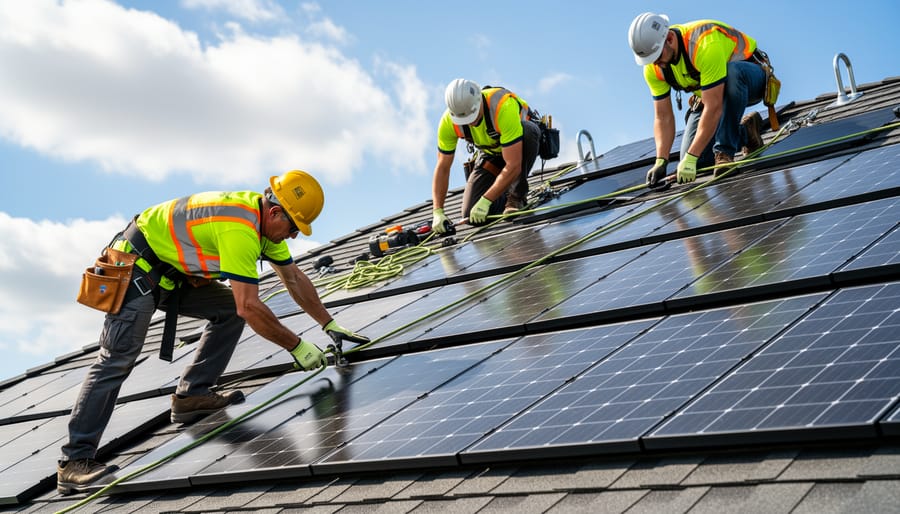
Solar shingles aren’t a typical weekend roofing project. The installation requires electrical expertise that goes far beyond hammering down asphalt shingles, you’re integrating a power-generating system directly into your home’s structure and electrical panel.
Each solar shingle must connect to an electrical circuit, which means running low-voltage wiring beneath your roof deck while maintaining proper waterproofing. One misplaced nail or improper flashing can create leaks that won’t show up for months. Professional installers understand how to route these electrical pathways without compromising your roof’s integrity or violating local electrical codes.
Building departments require permits and inspections for solar installations, and most won’t approve DIY work on integrated photovoltaic systems. The process involves coordinating with your utility company for net metering approval, which typically requires documentation from licensed contractors.
Warranty protection presents another barrier. Tesla, GAF Energy, and other manufacturers void their 25-year product warranties if anyone except certified installers handles the work. These warranties cover both the roofing function and energy production, representing tens of thousands in potential coverage you’d forfeit.
Safety concerns are significant. Working on a roof while handling electrical components creates serious injury risks. Professional crews carry liability insurance and workers’ compensation that protect you if something goes wrong. The specialized equipment needed, from proper fall protection to voltage testing tools, costs more than most homeowners would save attempting DIY installation.
Cost Comparison
Attempting to install solar shingles yourself might seem like a way to slash your budget in half, but the math rarely works out that way. Material costs for solar shingles run $15,000 to $25,000 for an average home regardless of who installs them. The labor you’d save by going DIY, typically $5,000 to $12,000, gets eaten up quickly by tool rentals, safety equipment, electrical permits you’ll still need to pull, and the learning curve mistakes that waste materials.
Professional installation delivers value that extends far beyond the initial invoice. Certified installers complete the job in one to two weeks with crews that have handled hundreds of roofs. Your DIY timeline stretches to months of weekends, assuming you have roofing experience and electrical skills. More importantly, professional work comes with warranties covering both labor and materials for 10 to 25 years. Self-installation voids most manufacturer warranties entirely, leaving you financially exposed if shingles fail or leak.
The hidden costs mount further. Professionals carry liability insurance covering potential damage to your home’s structure or injury on-site. You’d need to secure that coverage yourself. Code violations from improper electrical work can force expensive corrections and prevent your system from connecting to the grid, negating any savings. Factor in the resale impact too, professionally installed systems with transferable warranties add significantly more home value than DIY installations that prospective buyers view as risky.
How to Reduce Solar Shingle Costs
Federal Tax Credits and Incentives
The federal Investment Tax Credit (ITC) currently covers 30% of your total solar shingles installation cost, making it the single most valuable incentive available to homeowners. Unlike some solar incentives that apply only to photovoltaic equipment, the ITC includes both the solar-generating components and the structural roofing materials when they’re part of an integrated solar roof system, meaning you can claim the credit on a significantly larger portion of your investment than with traditional rooftop panels.
For a $50,000 solar shingle installation, you’d receive a $15,000 tax credit that directly reduces what you owe the IRS (not just a deduction). The credit applies to materials, installation labor, electrical work, permits, and even the removal of your existing roof when necessary for the solar installation. To qualify, your system must be installed on a property you own (primary or secondary residence) and placed in service during the tax year you’re claiming.
The 30% rate holds through 2032, then steps down to 26% in 2033 and 22% in 2034 before expiring unless Congress extends it. Since solar shingles function as both protective roofing and energy generation, understanding how panels generate electricity helps clarify why the entire integrated system qualifies, the ITC makes the premium cost substantially more manageable than paying the full amount upfront.
State and Local Rebates
State and local solar programs vary dramatically by location, but they can slash thousands of dollars from your installation cost. Start by checking your state energy office’s website, most maintain databases of current solar incentives. Many states offer cash rebates ranging from $500 to $5,000, while others provide property tax exemptions that prevent your solar shingles from increasing your assessed home value.
Your utility company may run its own rebate program separate from state incentives. Call their customer service line or visit their website’s renewable energy section to ask specifically about solar shingle or integrated solar roofing rebates. Some utilities offer performance-based incentives that pay you for every kilowatt-hour your system generates over several years.
The Database of State Incentives for Renewables and Efficiency (DSIRE) provides a searchable tool showing every program available in your zip code. Local programs through cities and counties sometimes offer additional grants or expedited permitting that reduces soft costs, so check your municipal government website too.
Timing and Financing Options
Scheduling your solar shingle installation during the off-season (typically late fall or winter in most regions) can sometimes yield better contractor rates, though weather may limit installation windows. Spring and early summer are peak seasons when demand drives prices higher.
For financing, solar loans let you own the system outright while spreading payments over 10-20 years. Interest rates typically range from 3-8%, which adds to total cost but preserves your eligibility for the full federal tax credit. Solar leases and PPAs eliminate upfront costs entirely, you pay monthly for the electricity generated instead. However, these arrangements mean you don’t own the system, can’t claim tax credits, and may complicate future home sales. Cash purchases remain the most cost-effective long-term option despite the substantial initial investment.
Solar Shingles vs. Traditional Solar Panels: Cost Comparison

Solar shingles cost roughly 50-100% more upfront than traditional solar panels for the same energy capacity. A typical 6-kW system using conventional panels runs $15,000, $18,000 before incentives, while achieving the same output with solar shingles often costs $30,000, $54,000 because you’re paying for an integrated roofing solution.
The price gap narrows when you need a new roof regardless. If your existing shingles have five years or less of useful life, replacing them costs $8,000, $12,000 on average. Add that to panel installation, and you’re looking at $23,000, $30,000 total, much closer to solar shingles’ all-in-one price. The real value comparison depends on your roof’s current condition and your timeline.
| Factor | Solar Shingles | Traditional Panels |
|---|---|---|
| Upfront Cost (6 kW) | $30,000, $54,000 | $15,000, $18,000 |
| Installation Complexity | Complete roof replacement required | Mounted on existing roof |
| Aesthetic Appeal | Flush, integrated appearance | Visible panels on racks |
| Efficiency (typical) | 14-18% | 18-22% |
| Lifespan | 25-30 years | 25-30 years (panels) |
| Ideal Use Case | New construction or roof replacement needed | Existing roof in good condition |
Traditional panels generate more electricity per square foot because they’re typically more efficient and can be angled optimally on adjustable racking. Solar shingles lie flat against your roof slope, which may not be the ideal angle for maximum sun exposure. Understanding solar energy basics helps you evaluate whether the efficiency difference matters for your energy goals.
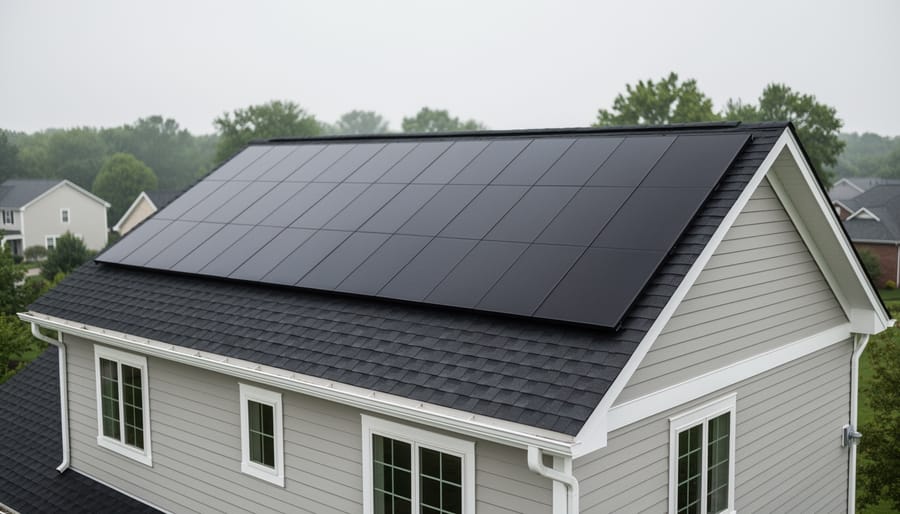
The aesthetic advantage of shingles appeals strongly to homeowners in neighborhoods with strict architectural guidelines or those who simply prefer a seamless look. That visual integration carries a premium, but it eliminates the concern about panels affecting your home’s curb appeal or resale value. For heritage homes or high-end properties, the extra cost often justifies the preserved appearance.
What Changes the Price
Several elements shift your final bill higher or lower once you’ve settled on a basic system size. Energy production goals matter, if you want to cover 100% of your usage rather than 50%, you’ll need more active solar shingles instead of cheaper non-solar shingles, pushing costs up. Your utility’s net metering policy affects how much value each kilowatt-hour generates, which changes payback calculations and willingness to invest in premium components.
Roof obstacles like skylights, chimneys, or vent stacks increase labor hours because installers work around them carefully. Structural reinforcement adds expense if your roof framing can’t support the weight of an integrated solar system without extra support. Choosing upgraded monitoring systems, battery storage, or premium inverters raises the initial outlay but can improve long-term performance and savings.
Incentive stacking lowers your net cost considerably. Combining the federal tax credit with state rebates, utility programs, and solar energy certificates in eligible markets can cut 40% or more off your total. Installation timing plays a role too, scheduling during contractors’ slower seasons sometimes yields better rates than peak summer demand.
Frequently Asked Questions About Solar Shingle Costs
Understanding the financial implications of solar shingles goes beyond the initial price tag. Homeowners consistently ask similar questions when weighing this investment, particularly around long-term value and hidden costs.
What’s the typical payback period for solar shingles?
Most homeowners recover their investment in 15-25 years through energy savings, depending on local electricity rates, system size, and available incentives. Homes in high-electricity-cost areas typically see faster payback.
Do solar shingles increase my home’s resale value?
Studies show homes with solar installations sell for 3-4% more on average, and solar shingles often appeal more to buyers than traditional panels because they’re integrated into the roof rather than mounted on top. The dual benefit of a new roof plus energy generation makes the value proposition particularly strong.
What ongoing maintenance costs should I expect?
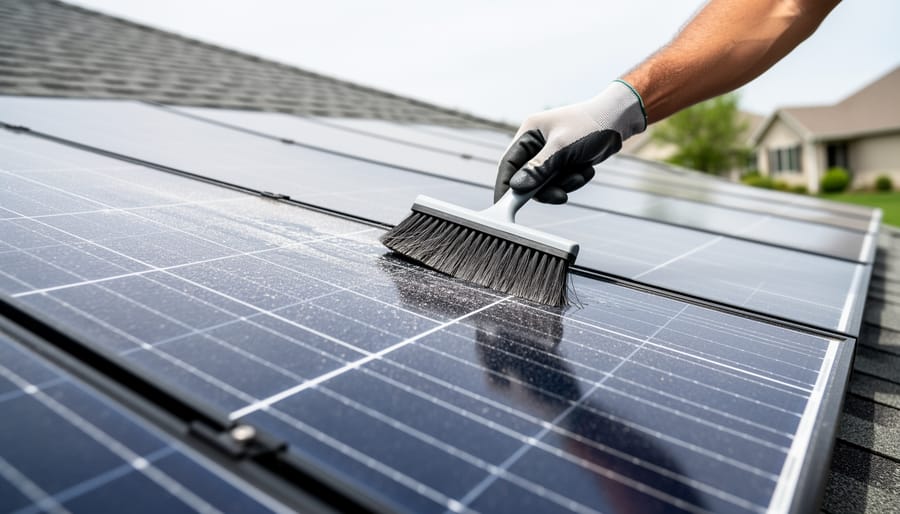
Solar shingles require minimal maintenance, typically just occasional cleaning and annual inspections costing $150-$300. Most manufacturers offer 25-year warranties covering defects and performance guarantees.
Will my homeowners insurance cover solar shingles?
Most policies cover solar shingles as part of your roof, though you should notify your insurer about the installation. Some carriers may increase premiums slightly, while others offer discounts for energy-efficient home improvements.
The return on investment calculation involves more than simple math. Energy savings vary substantially based on your household consumption, local utility rates, and whether your area has net metering policies that credit excess production back to your account. Some homeowners see monthly electric bills drop to zero or even generate credits during peak production months.
Financing fundamentally changes the economics. Solar loans spread the cost over 10-20 years, meaning your monthly loan payment might equal or fall below your previous electric bill from day one. Power purchase agreements eliminate upfront costs entirely, though you sacrifice the federal tax credit and long-term ownership benefits.
Compared to traditional solar panels, shingles cost more upfront but eliminate the need for separate roofing replacement. If your roof needs replacement anyway within the next few years, solar shingles often prove more cost-effective than installing a new roof plus separate panels. The aesthetic advantage matters too, particularly in neighborhoods with strict appearance standards or for homeowners who simply prefer the integrated look. That visual appeal can translate directly into higher resale premiums when you eventually sell.
Solar shingles represent a significant upfront investment, typically $45,000 to $75,000 for most homes, but you’re paying for two systems in one. Unlike bolting panels onto your existing roof, you’re getting complete roof replacement that generates electricity for 25-30 years. That dual functionality changes the value equation considerably.
The final price for your project depends on roof size, complexity, location, and the brand you choose. Federal tax credits currently cover 30% of total costs, and many states offer additional rebates that can reduce your out-of-pocket expense by thousands more. These incentives won’t last forever, making 2026 an opportune time to act.
Getting multiple quotes is essential. Installation quality varies dramatically between contractors, and pricing can differ by $10,000 or more for identical projects. Compare not just the bottom line but warranty terms, installer experience with solar shingles specifically, and projected energy production.
Ready to explore what solar shingles would cost for your home? Connect with qualified local installers through Ask Solar to receive personalized quotes based on your roof’s specifications and energy goals. The right installer will provide detailed projections showing exactly how your investment pays back over time.